How One 8th Grader Turned a Class Project into Real Climate Action
Jun 19, 2026
Hailey Nosho isn’t waiting for “someday” to care about the planet. She’s an 8th grader at John Adams Middle School in Santa Monica-Malibu USD, California, and she’s already talking trash, recycling, compost, and climate action like it’s just part of her homework.
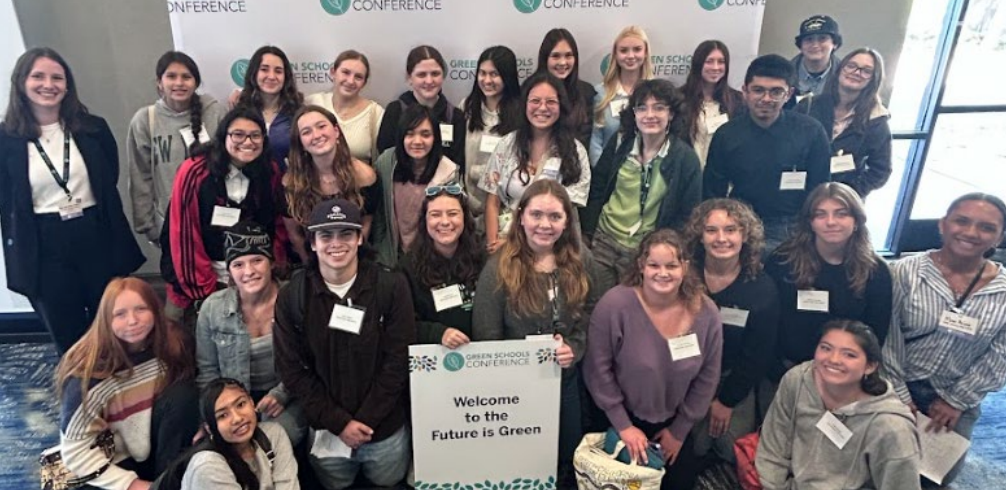
Hailey has recently spoken at two major events, the 2026 Green Schools Conference hosted by the U.S. Green Building Council's Center for Green Schools and the national Green Spark Event, hosted by Green Schools National Network. Green Spark featured student sustainability leaders from across the country. As the winner of the Students Speak Out for Climate Contest, Hailey's daily practices and storytelling about her Civic Action Project have inspired young people and adults around the nation.
Climate change isn’t an abstract future problem to her. It shows up as litter, heat spikes, wildfires, and a constant stream of bad environmental news. “It's changed how I think about the future,” she explains. “Instead of assuming things will just click into place or work out, it feels like my generation is having to actively work harder and harder to fix the problems that we didn't create. It feels more like a clock running in the background at all times in the back of my brain; a pressure knowing we don't have time to wait.”
Still, Hailey has found ways to turn that pressure into action. She’s a role model for other teens who also bring lunch from home. “I take leftovers from the night before, put that into a reusable container, and bring my own dishwasher-safe forks and stuff. My mom sews a lot, so she made some reusable napkins.”
At John Adams, 8th graders complete an eight-week Civic Action Project that affects their school. Hailey chose a topic she genuinely cares about, with a goal that students can actually reach.
She noticed that the school’s recycling dumpster is mostly full of cardboard boxes, with almost no student recyclables. Her idea: add recycling bins with clear signage right next to every trash can in the quad, with images of common cafeteria items.
“From the people that I've talked to so far, it takes them two extra seconds to put it into the right bin,” she says. “But if they have to stop and think about it, it's like, “Where does this go?” They're just going to throw it in the trash. Or if they have to walk farther to get to the recycling bin when the trash is right next to them. Having the trash and recycling bins right next to each other, with logos saying where each thing goes, would be really beneficial for my school.”
To make that happen, Hailey plans to speak with her science teacher and the district sustainability director, team, and consultants. They can help her follow state rules about placement and signage and find the right equipment.
The Center for Green Schools offers free online courses to support school system sustainability action, including the Zero-Waste Cafeteria series and a Behavior Change webinar.
She’s also thinking about getting the word out through Friday announcements, a possible advisory assembly, and maybe even a partnership with the Associated Student Body, a student-led group with funding. She, as an 8th grader, only recently found out about the compost bins hidden behind the cafeteria.
Hailey isn’t the only one connecting classwork and climate. At her school, one group is surveying students about cafeteria food, so the food director can plan menus that people actually eat instead of throwing away.
Another group project focuses on water fountains and refill stations to make reusable bottles easier to use.
Other students are testing campus trees to protect them from disease, using resources like the Arbor Day Foundation’s “Tree Campus K-8” program.
Even when your project isn’t “about” the environment, you can still sneak sustainability into it. If your group wants new field equipment, for example, you could pick gear lots of students will actually use and look for options that last longer or create less waste instead of the cheapest thing that breaks in a semester.
Her own love of sustainability started earlier. Hailey credits her elementary school’s community garden, where students grew food for the cafeteria, and used a compost wheel to create nutrient-dense soil. That hands-on experience, she admits, “probably encouraged me to go more into things like sustainability with the climate action project and the essay, (Go Geckos!)”
She also knows that middle school life is packed: theater, sports, music, art, engineering, and everything else. One approach is to keep doing what you love, but through a different lens. Keep asking: Is there a way to make the activity I'm currently engaged in more environmentally friendly?
Hailey sees that every student brings something different to this work. “Each student has a way of demonstrating what they like to do in their own specific way,” she explains. “One might be more memorable to people in the community, and one might be more effective. People might see things differently based on how you do it. But no matter what, you're still reaching for the same central idea of what you want and how you want to approach things.”
“Especially in middle school, people look at others and wonder, 'How did they do it?' If you start doing something that's better for the environment, you can influence people a lot,” she says. “It's easier to talk to someone your age to get them to just do one small thing. It's like getting metal forks. It's a one-time purchase, and you get more use out of them. It's overall cheaper. Stuff like that, where you can just slightly influence people on how to do something, is probably the best way a middle schooler can just slightly change the environment,” she says with a smile.

If you would like support completing a civic action project assignment for your school, sign up for our Climate Action Lab for individuals. You will have support while you choose a cafeteria issue you care about, design a realistic action, and try it out in your school.
Each of you also carries inspiring stories, innovative ideas, and real-life experiences that your peers need. You are the most effective ambassadors for getting more students involved in environmental conservation, starting with places you already know well, like your cafeteria.
If you’ve completed an assignment that reduced cafeteria waste at your school, Cafeteria Victories would love to hear about it. You don't need to be in a formal Green Team or promise a lifelong commitment to the environment to make an impact. Reach out to share your story through Cafeteria Victories' “Spotlight Our School” articles.
Your voice matters. Your actions make a difference. Together, we create a more sustainable present.
*Green Schools National Network partners with schools and districts leading the way in strategically integrating sustainability both operationally and academically.
Food is where our relationship with the Earth gets personal.
The choices we make create the lunchtime we experience. Are you having your ultimate lunchtime experience every day? If not yet, have you decided what problem in your school community's relationship with lunch you want to solve? Tell us about it and we'll find other schools who have a solution.
We will never sell your information, for any reason.